Garage Doors
Helpful reading
Short answers
Does winter change what you look for?
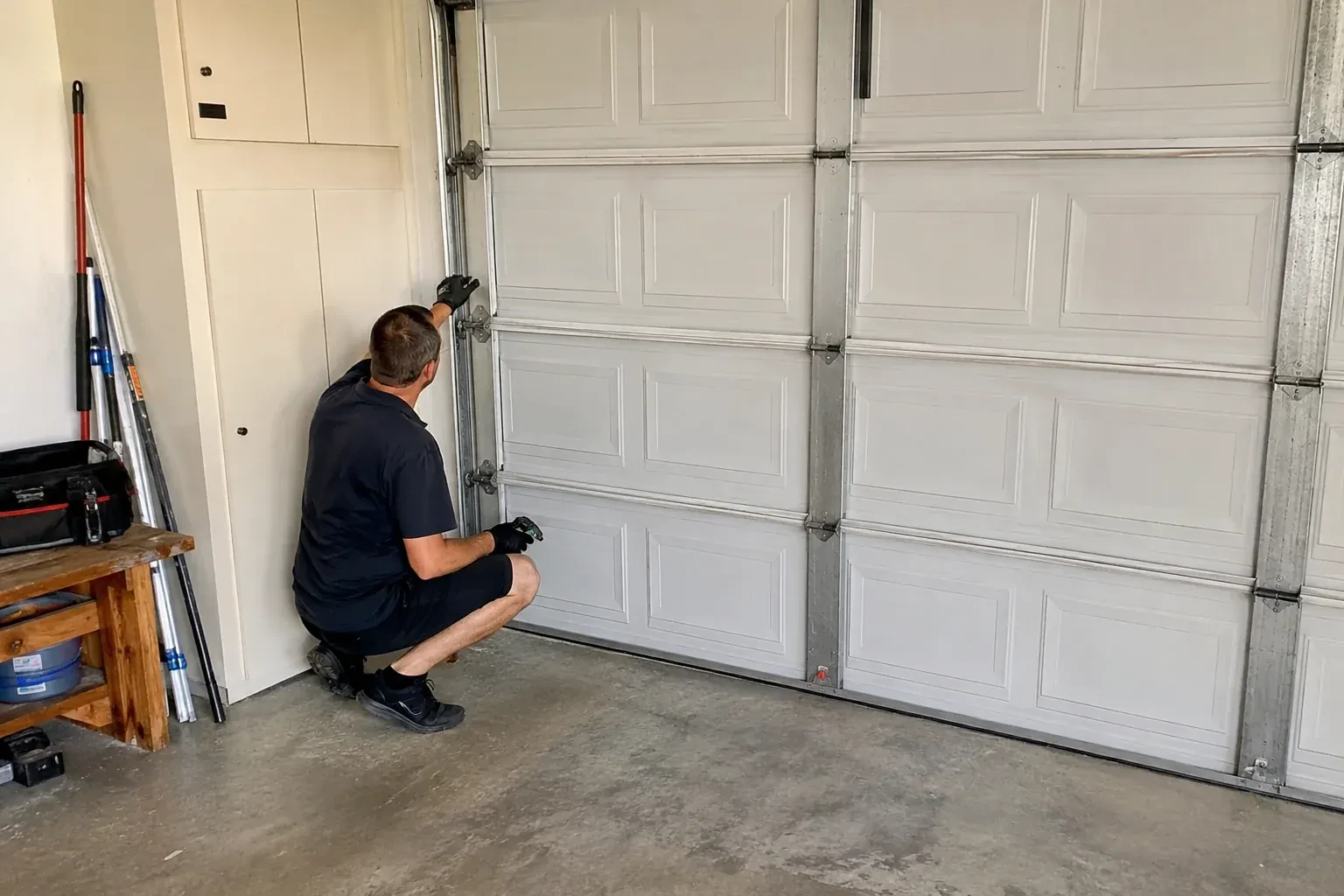
Yes, mostly at floor level. Months of slush and road salt reach the lowest hinges, the bottom brackets and the loop of each cable before anything else on the door, so those get a close look for rust. The technician also checks whether the bottom seal has been freezing to the slab, how the drive has coped with cold, stiff starts, and whether frost or salt film has been blinding the sensors near the floor.
What happens if a broken spring is found during the tune-up?
The door is left closed and not operated with the opener, because a door with a broken spring weighs its full weight and can drop. The technician explains what was found, shows you the break, and quotes the spring replacement as its own job, usually replacing both springs on a two-spring door so they wear evenly. The rest of the tune-up either waits or continues on the parts that can safely be serviced with the door down.
Our shop's overhead door was hit by a delivery vehicle. Is this the same service?
Yes, with the extra weight and size of a commercial door taken into account. The door is secured, the impact damage to sections, track and brackets is assessed, and the reset is paired with whatever track or hardware replacement the strike requires. Because the opening usually needs to be secured before the premises can close for the night, tell the technician when you call so the right track profile and rollers arrive with them.
How do you work out which make and model my door is?
The manufacturer's label is the starting point. It is often a sticker on the end of a section, on the inside of the top section or on the vertical track, and it usually gives the model or series, a date and sometimes a colour code. Failing that, the panel design, section heights, thickness, joint profile and hinge spacing narrow it down, and the distributor can usually confirm the model from photographs and measurements.
Can mice get past a garage door bottom seal?
A worn, hardened or chewed seal is one of their favourite routes, and even a small gap at a corner is enough. A fresh, continuous seal sized to the floor removes that route. For a garage with repeated trouble, seals with a stainless mesh embedded in the vinyl are available and resist chewing. Keeping the jamb seals sound at floor level matters just as much, since a gap beside the door serves them equally well.
How is the seal fastened to the frame?
A flexible fin is nailed or stapled to the face of the wood stop with galvanized or stainless fasteners spaced evenly along its length; a one-piece vinyl stop is nailed or screwed through its rigid edge into the jamb and header. Fasteners go into sound wood, heads are set flush without crushing the vinyl, and the joint between stop and trim is caulked where water could get behind.
Can a bent lock bar be straightened?
It is better replaced. Lock bars are spring steel, and once one has been bent by an opener pulling against it, it takes a set and tends to bind in its guide or kink again under load. New bar stock is cut to the door's width so the bar reaches through the track with a margin and pulls fully back when released. Both bars are set to the same throw.
What does stem length mean and why does it matter?
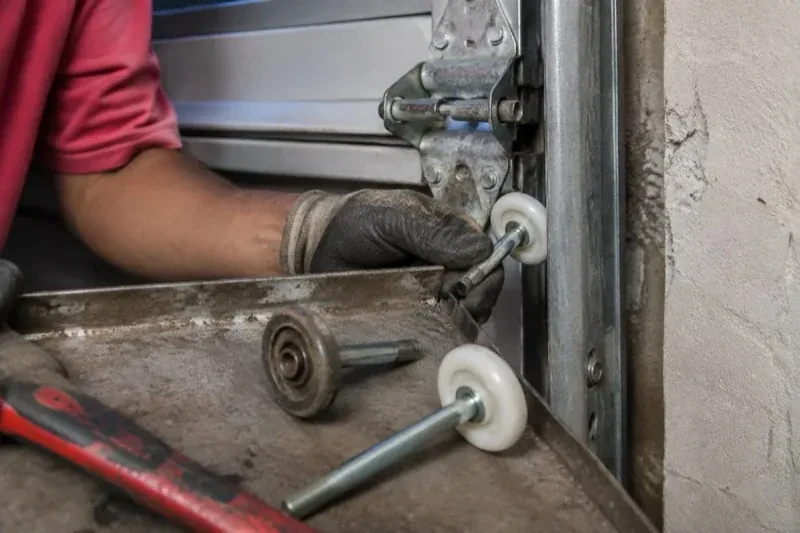
The stem is the steel shaft that passes through the hinge or fixture and carries the wheel. Most residential doors use a four-inch stem through a single hinge. Heavier doors have two hinges stacked at the ends of each section, and those need a seven- or ten-inch stem so the shaft reaches through both. A short stem in a double hinge sits loose, lets the wheel lean, and is a common reason a door leaves its track. The technician counts the hinges before choosing the set.
How should I lubricate the hinges?
A short burst of silicone or white lithium spray made for garage doors on each hinge knuckle and roller stem, spring and autumn, then run the door a few times to work it in. Wipe away any excess. Skip heavy grease and general-purpose oil, which trap grit and salt against the steel. Leave the track dry and simply wipe it clean, since lubricant in the track makes wheels slide instead of roll.
Should I keep using the opener while the track is bent?
It is better to leave the door where it is and use another way in and out. An opener pushing a door through a damaged section pulls rollers out of the channel, twists the top section and can turn a small dent into a jammed door off its track. Industry guidance after any impact is to stop operating the door and have it assessed. Leaving it still keeps the repair small.
Should I lubricate the cables?
A light film, yes. A mist of silicone or a lubricant made for garage doors on the cables, especially the lowest stretch near the brackets, sheds moisture and slows rust. Avoid heavy grease or oil, which holds grit and salt against the strands. The springs, hinges, roller bearings and bracket pins take the same product a couple of times a year, and the tracks are simply wiped clean.
My car is inside the garage; how do you get the door open?
Once the technician is on site, the door is secured and the spring replaced with the door in its closed position, which is how spring work is always done. When the new spring is wound and the door balances, it lifts normally and the vehicle drives out. There is no need to force the door open beforehand; leaving it closed keeps the door square and the job straightforward.
Can I use the door as soon as the work is done?
Yes. The last steps of the visit are the balance test by hand, several full cycles under power and the opener's reversal checks, so the door is ready for normal use when the technician leaves. New springs need no settling period. It is worth running it yourself once or twice while the technician is still there, so you know what a properly balanced door sounds and feels like from now on.
Why does my door sink or slam down when released?
Not enough spring tension for the door's weight. Springs lose a little pull as they age through thousands of cycles, and a door gains weight when insulation, windows or a heavier seal are added. Either way the door outweighs its springs. Adding tension in measured quarter turns restores the hold, provided the springs are sound; if they are near the end of their life, new ones are the right answer.
What is the red cord for, and is it safe to pull?
It is the emergency release that disconnects the door from the opener so you can move it by hand, for instance during a power outage. It is safe when used with the door closed. Pulling it with the door open is the risk, because an unbalanced door can then drop. Pull straight down, lift the door by its handle, and reconnect afterwards by running the opener or lifting until the trolley clicks back in.
Should I oil the chain?
Follow the opener's manual, and lean toward less. Many makers ask for the chain to be left dry or given only a very light treatment, because a heavily oiled chain collects grit that grinds the sprocket and drips onto the car. The grease that matters is white lithium on the rail where the trolley runs, renewed every two or three years, and on the gears inside the head, which the technician packs during a repair. Penetrating sprays are kept away from the whole drive.
Should the belt be lubricated?
No. The belt is meant to run clean and dry; oils and sprays soften the rubber and gather grit in the teeth, which wears the sprocket. Lubricant belongs on the door instead: hinges, rollers and springs get a garage-door lubricant once a year. The gear inside the motor head takes a light grease when it is serviced, and that is the technician's job.
How long does an opener replacement take?
Plan on about half a day for a straightforward swap on a balanced door: removal, hanging the new rail and head, wiring the sensors and console, setting travel and force, running the safety tests and programming remotes. If the door balance check turns up spring or roller work, or a receptacle needs adding by an electrical contractor, allow extra time or a second visit for that part.
Do sensors wear out with age?
They do, slowly. The infrared emitter and the receiver dim over many years, lenses craze or cloud from sun and salt, housings crack, and water finds its way in at floor level. A pair that needs re-aligning more and more often, or whose light drifts between steady and flickering with nothing touched, is usually ageing. Because pairs are matched to the opener, an older opener is worth identifying early so the right replacement is on hand.
Will unplugging the opener reset the remotes?
No. The stored controls survive a power cut or a long unplugging; the opener remembers them when power returns, and manufacturers say this plainly. Removing a control is done at the learn button, following the model's sequence, either by erasing the whole memory or, on some models, by deleting a single device through a supported wall control or app. That is reassuring after an outage and important after a lost remote.
Does the controller need the photo-eye sensors to work?
For remote closing, yes. Controllers built to the operator standard check for a working sensor circuit before allowing a close from out of sight, and the door must stop and reverse if the beam is broken. Opening remotely and checking status generally work regardless. If your photo eyes are missing, dark or misaligned, they are put right as part of getting the door ready for the feature you actually want.
The outside release lock froze. How do I stop that happening again?
Salt spray and meltwater get into the keyway during a thaw and freeze overnight, the same way they do in a house lock. Keep the cylinder face clear of slush, give it a puff of dry lock lubricant before the cold sets in, and carry a small de-icer through the winter. A weather cap over the cylinder helps on a door that faces the road. The technician cleans and treats the cylinder as part of any outside release repair.
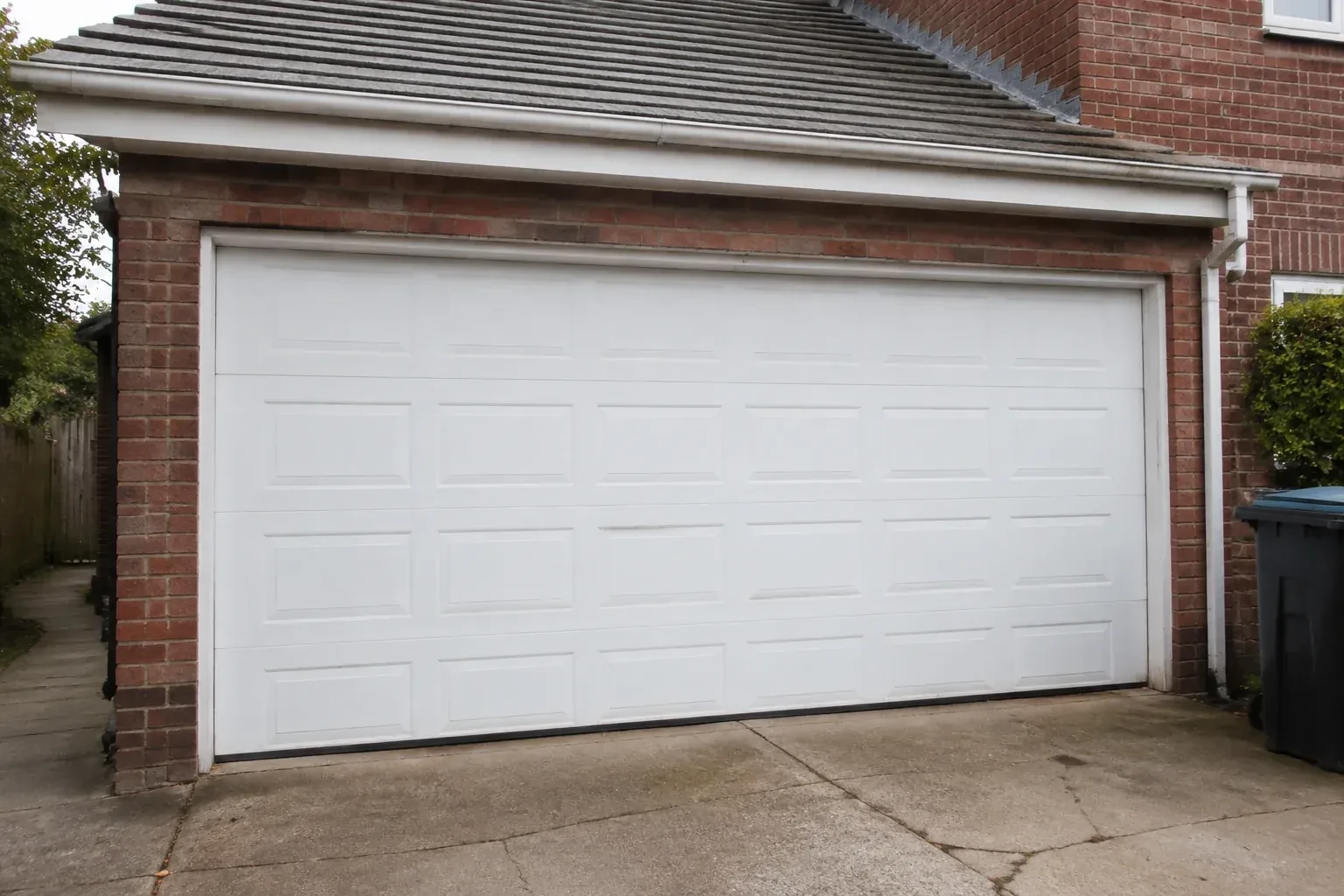
How can I tell if the balance has changed later?
During a planned manual check, a meaningful change may appear as a door that feels much heavier, will not remain controlled at an intermediate position or begins moving unevenly. New cable slack, rubbing or abrupt travel also deserves attention. Note the position and behaviour, then keep the door still for a technician's assessment.
When should installation wait for other work?
The project may be sequenced after framing repairs, masonry work, floor correction, electrical preparation or removal of an obstruction in the travel zone. Identifying that dependency during measurement protects the selected door dimensions and attachment plan. The proposal can separate door work from tasks handled by another trade, with a clear condition that must be ready before fitting begins.
How do insulation and weather seals fit into the project?
Insulated section construction can add stiffness, comfort, and weight, while perimeter seals limit drafts and ordinary moisture entry around the closed door. These choices are coordinated with the wind-rated configuration rather than selected separately. Bottom seal contact, side weatherstrip, and top seal alignment are checked during handover so the reinforced assembly also closes neatly for daily use.
How long does a carriage-house installation take?
The schedule depends on the number and size of openings, removal conditions, track layout, decorative assembly, opener work and whether the jambs or threshold need preparation. Custom materials and glazing also affect the ordering stage before site work. A useful proposal separates product lead time from installation activities and identifies any structural, electrical or finishing work that must be completed in sequence.
Will a glass garage door keep out winter drafts?
Insulated glazing, section seals, perimeter stop mould and an even bottom seal can improve enclosure performance when they are selected and fitted together. Draft control also depends on jamb condition, floor shape and the rest of the garage envelope. The assessment matches the construction to how the room is used and checks seal contact after the door is aligned.
Is an insulated garage door worthwhile for this project?
Insulation is especially relevant when the garage is heated, attached to living space or intended as a workshop. Door construction, section joints, glazing and perimeter seals all influence the enclosure, so an insulated section alone is only one part of the decision. The chosen thermal performance should be compared on consistent product information, then coordinated with door weight because the counterbalance system must match the completed assembly.
Why is the door lifting higher on one side?
Uneven travel commonly points to a lift-cable or drum issue, though a displaced roller, bent track or damaged bottom fixture can create a similar angle. The door is supported first, then both lifting sides are compared for cable condition, drum seating and hardware position. Correcting the cause and restoring equal tension brings the bottom edge back to level movement.
How often should a commercial rolling door be inspected?
Follow the door and operator manufacturers' intervals, adjusted for cycle count, exposure, impacts and facility conditions. Industry guidance supports periodic technician inspection at least annually for rolling doors, while a labelled fire door also follows the applicable fire-safety inspection and testing requirements. Visible facility checks between visits help identify changes early.
Which parts are commonly replaced in a conversion?
Typical system changes include vertical and transition track, raised horizontal track supports, high-lift drums, longer lift cables, calculated torsion springs and related shaft or bearing hardware. Top fixtures, rollers, brackets and the operator arrangement may also change according to the design. The final list follows measured compatibility rather than a universal kit applied to every door.